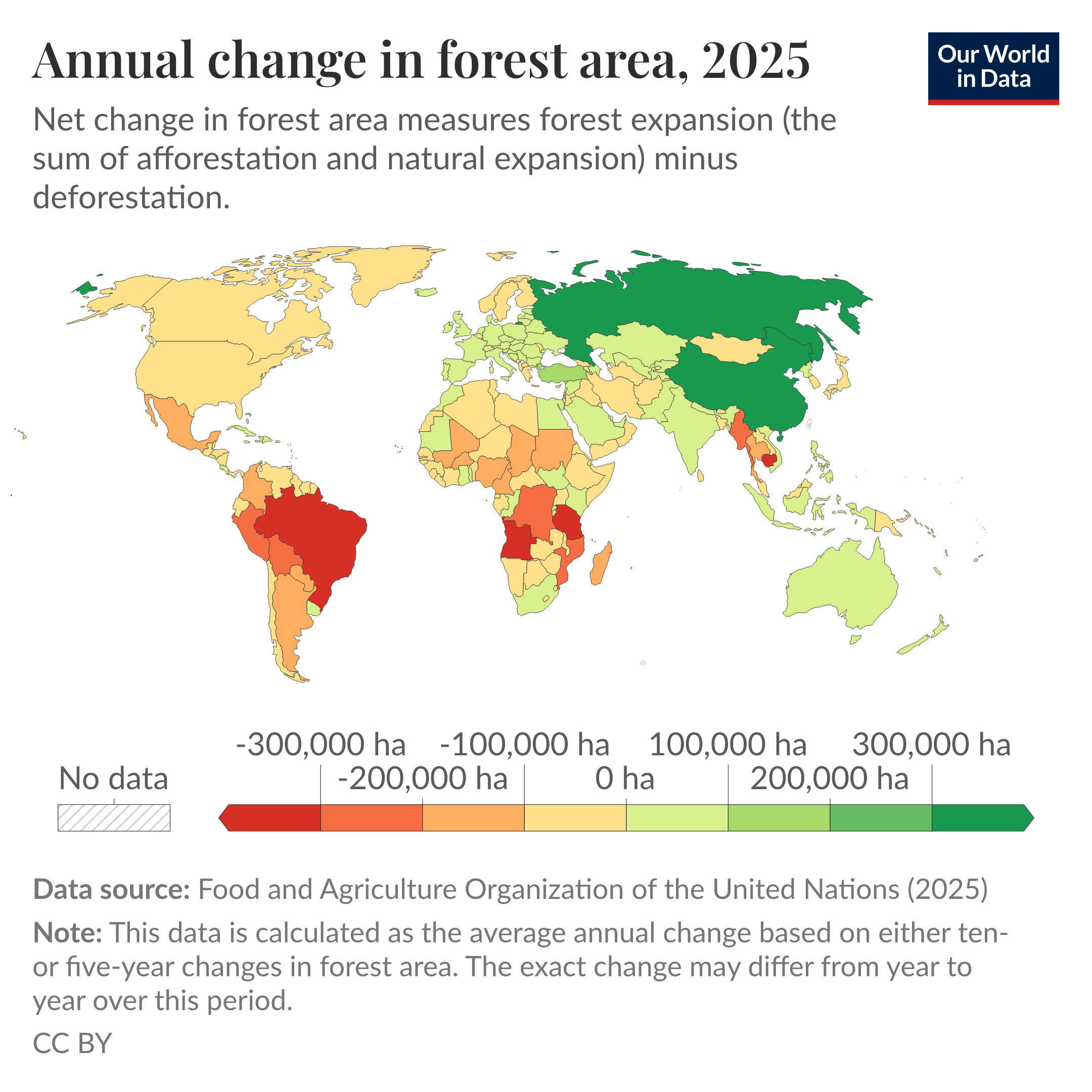
How are forest sizes changing around the world? Where is deforestation happening most, and where are forests actually growing in size through afforestation or natural expansion?
To help you track this, I recently updated our charts with the latest data from the UN FAO’s Forest Resource Assessment, which is published every five years.
The data shows that net deforestation has increased globally to around 5 million hectares (ha) per year for 2020–2025, driven primarily by deforestation in Brazil of 3.3 million ha per year. For context, there are about 4 billion ha of forest globally.
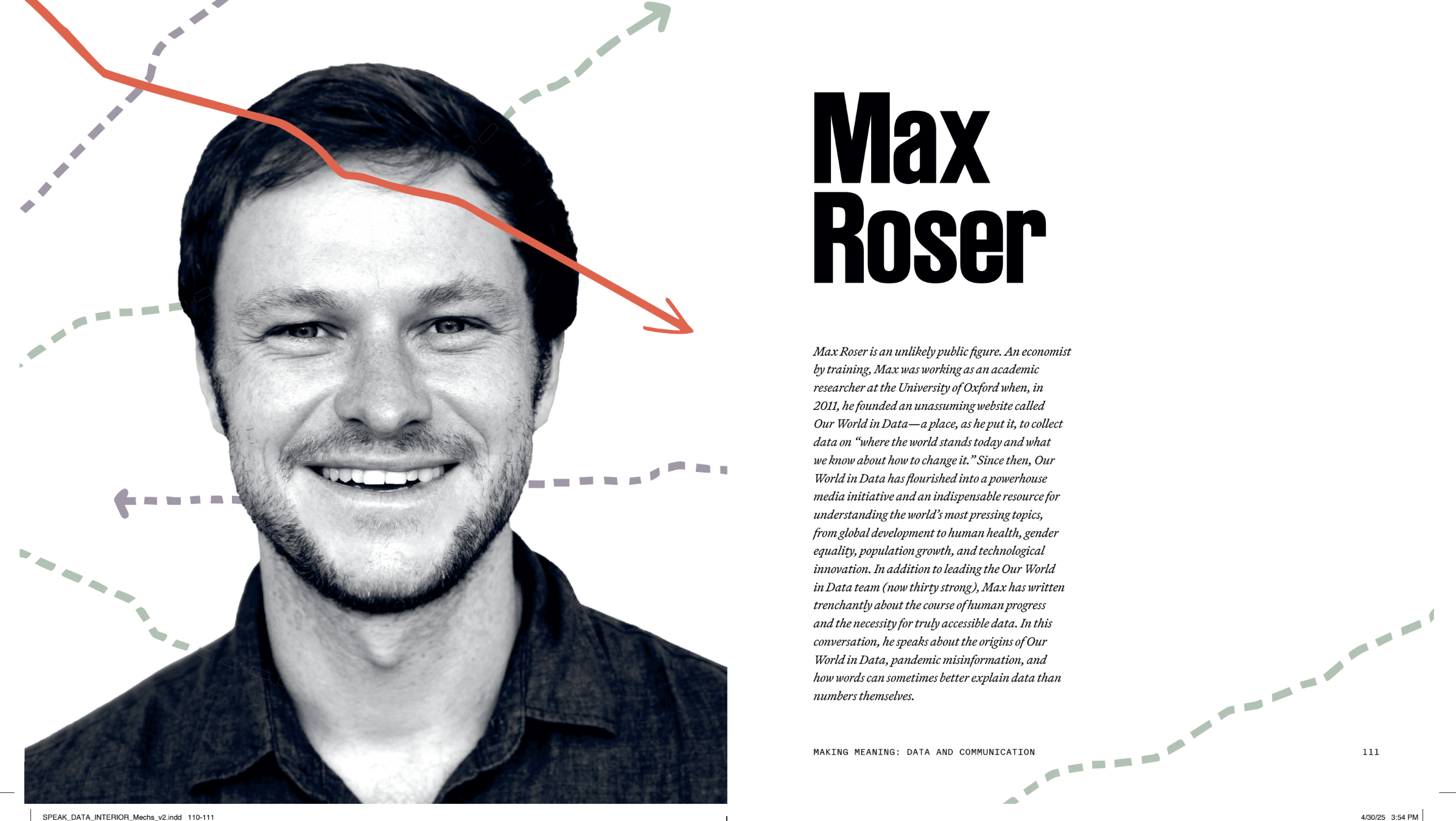
Max Roser, our founder and co-director, was interviewed as part of the book Speak Data: Artists, Scientists, Thinkers, and Dreamers on How We Live Our Lives in Numbers by Giorgia Lupi and Phillip Cox.
In the interview, Max speaks about pandemic misinformation, how words can sometimes better explain data than numbers themselves, and the origins and mission of Our World in Data:
With many of the things where we see big improvements, the data is not there, or it’s in the hands of researchers who bury it in the appendix of some PDF. That’s very much the angle that we are taking at Our World in Data—we’re trying to bring the data out of spreadsheets and visualize it, make it accessible for everyone.
The authors describe the book as “about data as a language and the ways it helps us access the full complexity of human ideas, stories, and behaviors.”
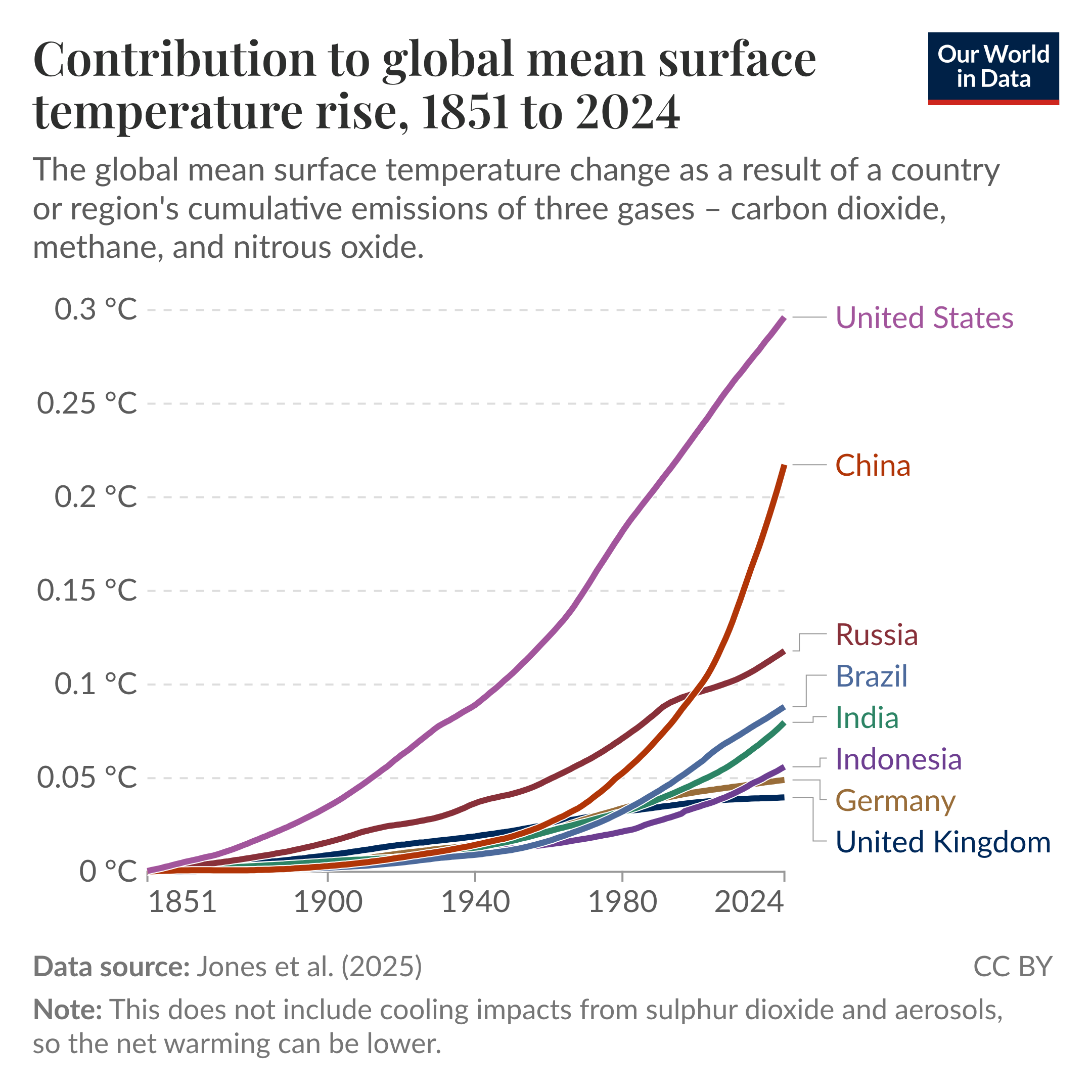
To limit and stop climate change, we need to greatly reduce global emissions of greenhouse gases (GHGs).
Our CO₂ and Greenhouse Gas Emissions Data Explorer lets you track how emissions are changing country by country, and also understand their impacts on the climate.
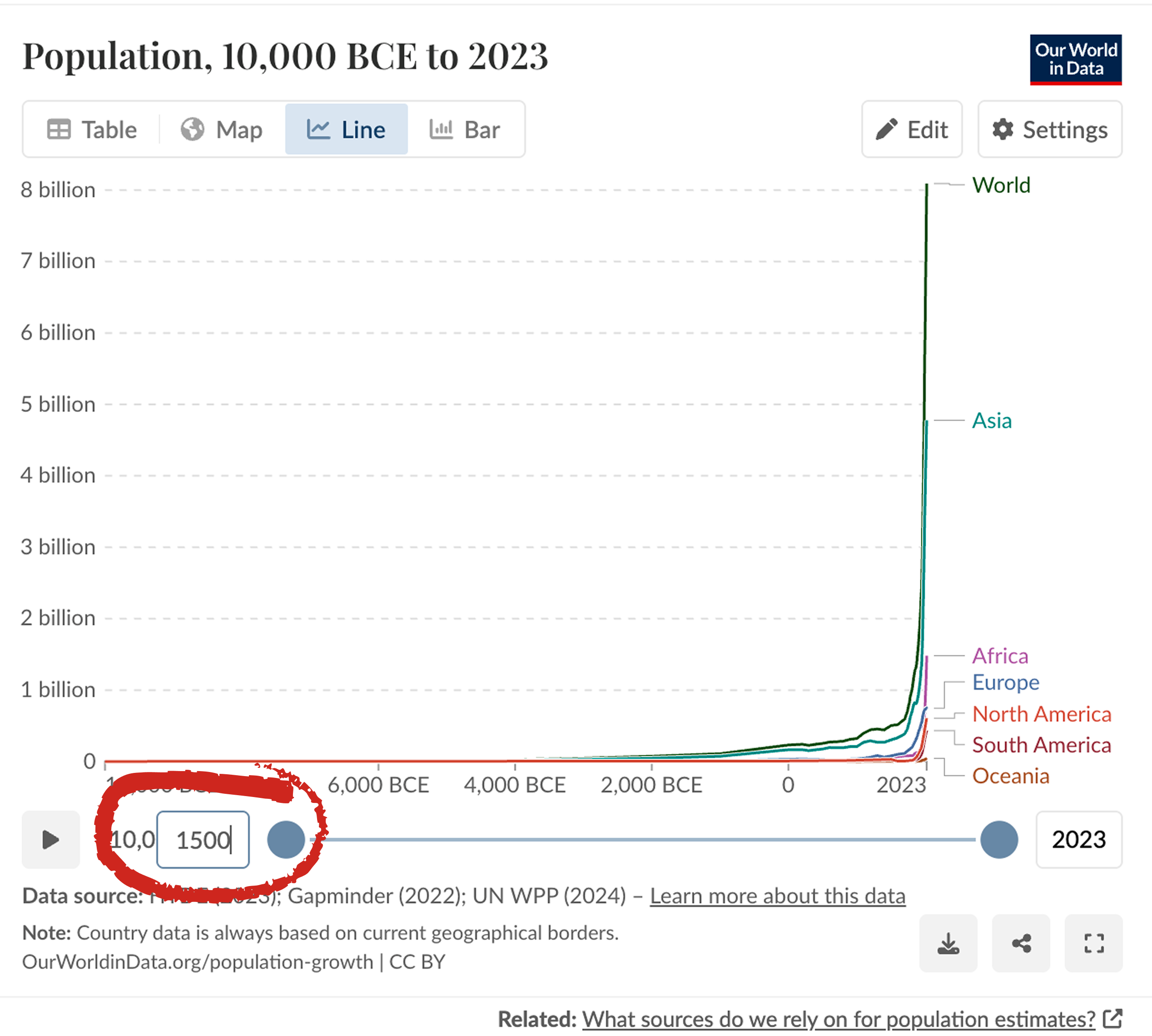
Many of our interactive charts feature long time series, and it can be difficult to select the exact year or date that you want to see data for.
I recently upgraded our data visualization tool to make this much easier — now you can simply type a specific year or date in the timeline at the bottom of a chart to select it.
Just hover over the timeline selector and a text box will appear. This is currently only for desktop users.
I hope this is a helpful new feature! We love feedback — let us know what you think by filling out our feedback form.
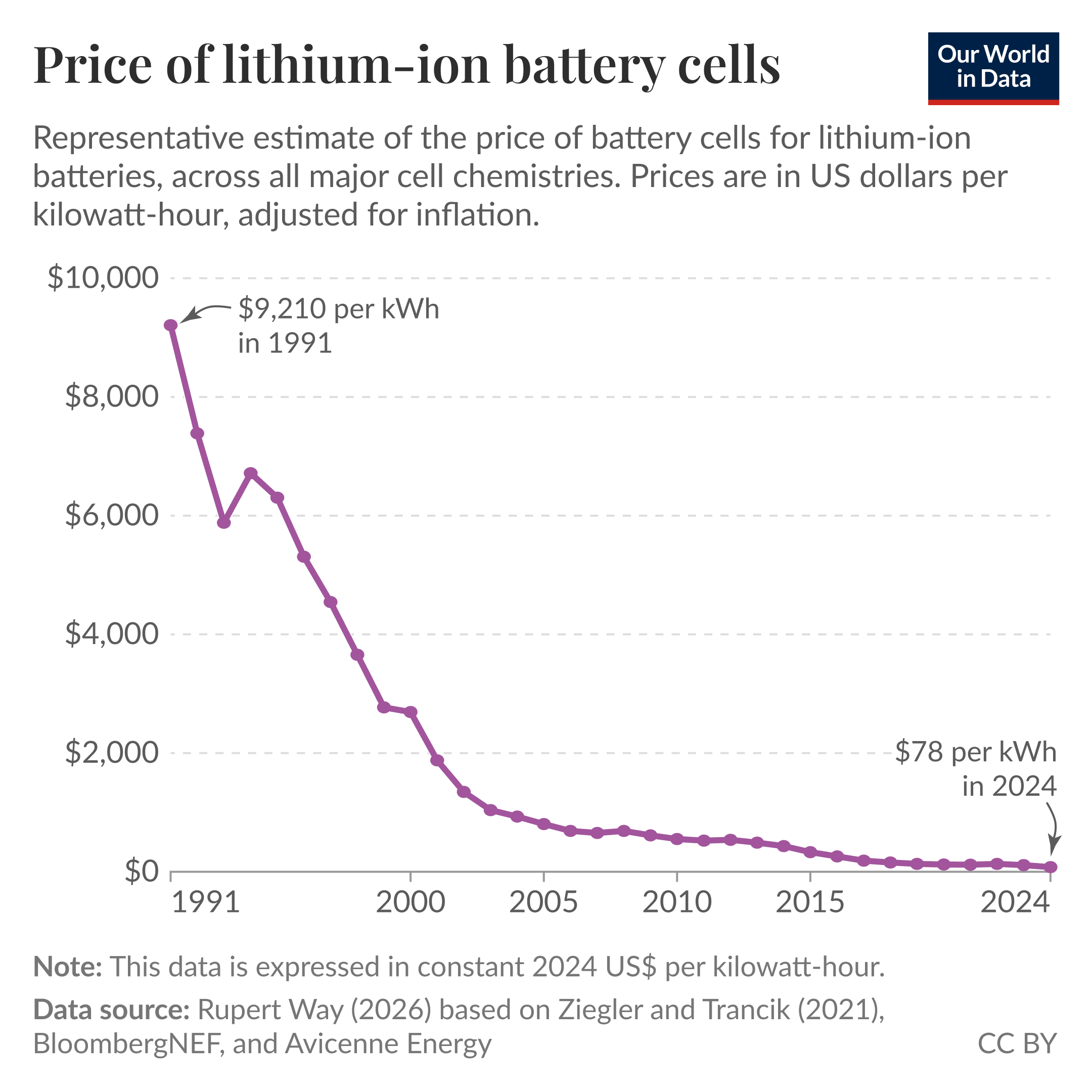
To transition towards low-carbon energy systems, we need low-cost energy storage. Lithium-ion batteries are the most commonly used.
I’ve updated our charts with the latest data on lithium-ion battery prices. As you can see in the chart, these prices have fallen by more than 99% since 1991.
This data was compiled by researcher Rupert Way from the University of Oxford, based on multiple sources.
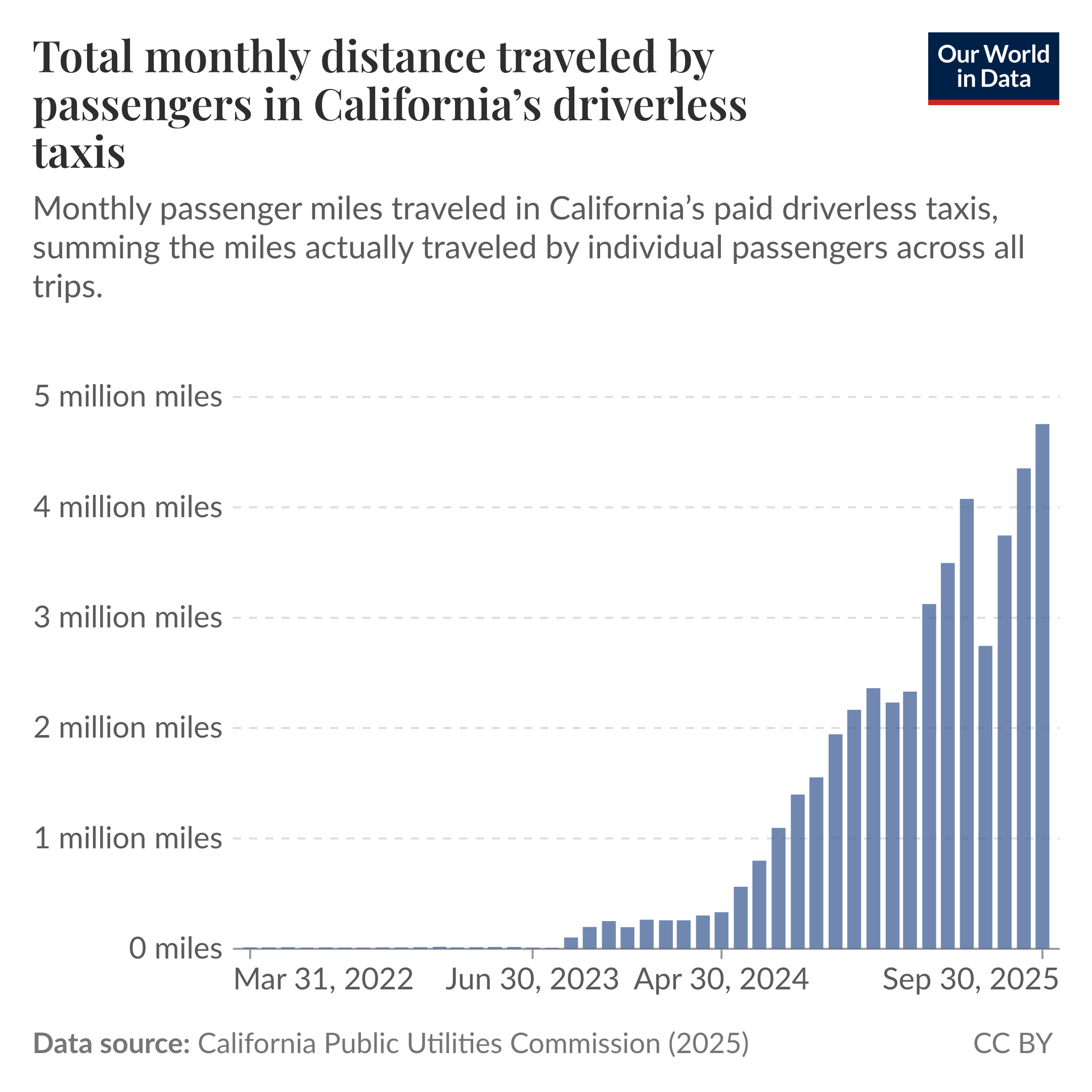
California’s driverless taxis now transport passengers for nearly five million miles per month. Although they still make up only a fraction of taxi trips in the state, they are expanding quickly.
In August 2023, California regulators fully approved self-driving taxi services in San Francisco for companies Cruise and Waymo. However, Cruise stopped operating in late 2023 due to safety and regulatory issues, so the recent growth reflects only Waymo’s service.
Trips stayed under half a million miles per month until mid-2024. But since then, growth has taken off, reaching nearly five million miles by September 2025, the latest data available.
I recently updated this chart based on the latest report, and will do so every quarter going forward.
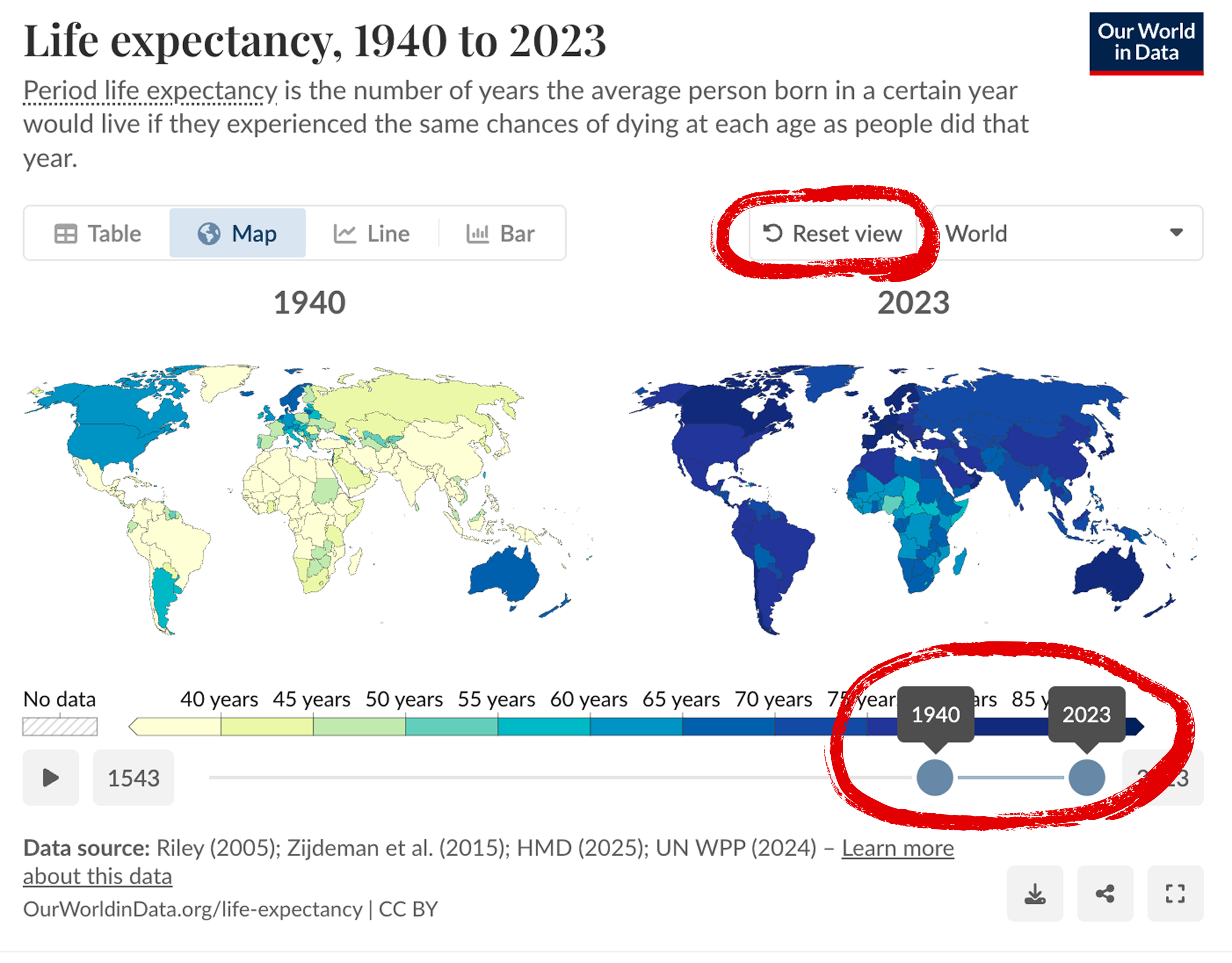
A useful way to look at change over time for an indicator is to view two maps showing different years side by side.
I recently upgraded our data visualization tool, the Grapher, to be able to do this!
To view two maps, just click on the timeline at the bottom to add a second time handle. You can then drag that handle left and right on the timeline to change the years shown.
To go back to a single map, you can either drag one handle back onto the other, or click “Reset view” at the top (only available on larger screens).
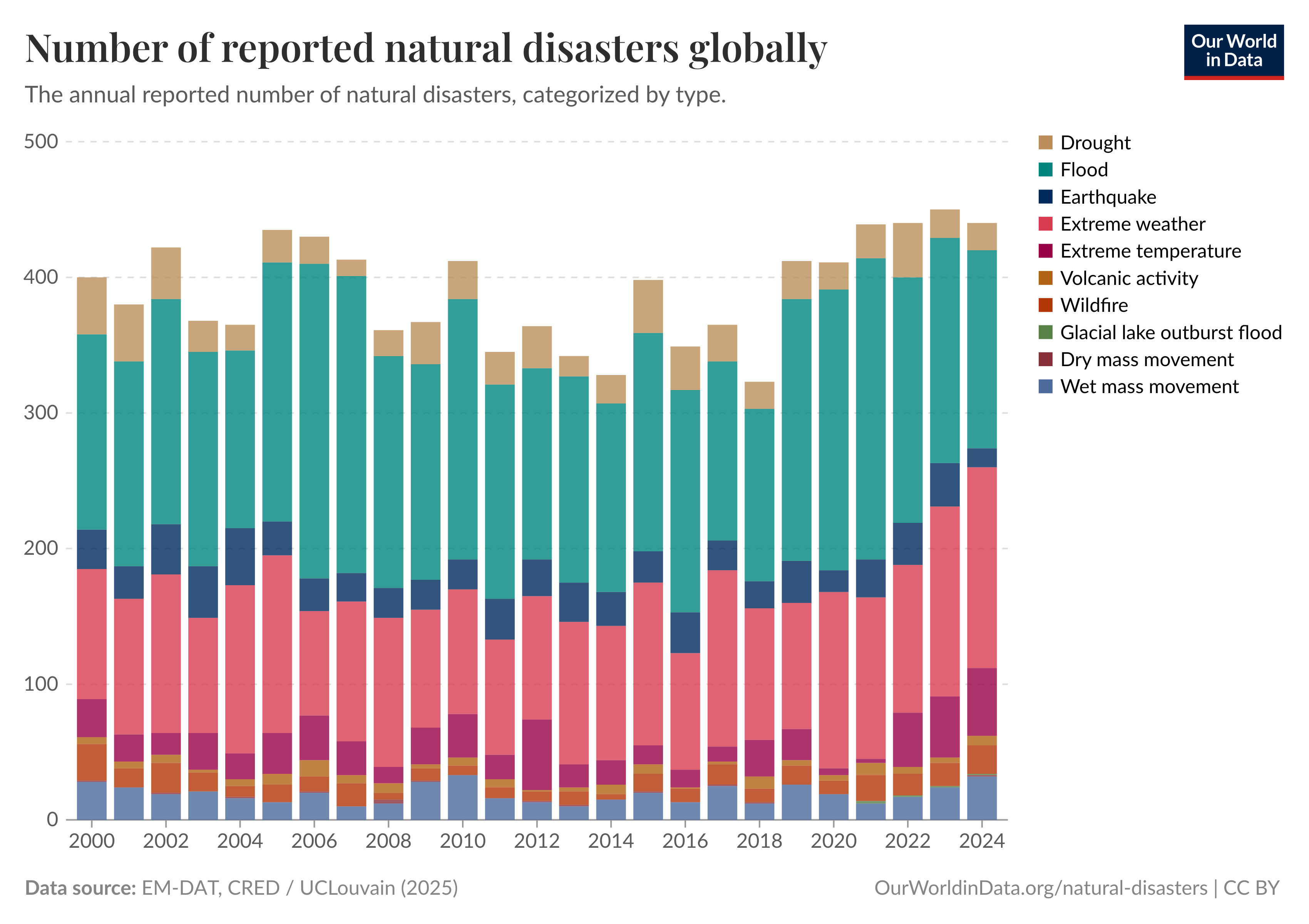
Tracking the occurrence of natural disasters can save lives by helping countries prepare for future ones.
In our work on natural disasters, we visualize data from EM-DAT, the most comprehensive international disaster database. EM-DAT is maintained by the Centre for Research on the Epidemiology of Disasters (CRED), part of the University of Louvain (UCLouvain).
I’ve just updated our charts with the latest data on natural disasters. This data helps us track where disasters are happening; what types of events they are; their human and economic impacts; and how these trends are changing over time.